Sunday, 23 January 2022

Pink Floyd's disastrous 1967 American tour

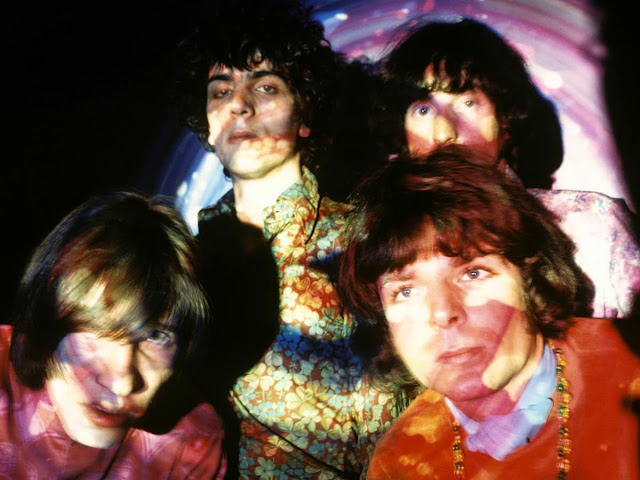
On November 1, 1967 the Pink Floyd left Britain for an eight day mini-tour of America to launch their album.

Roger Waters: “That was an amazing disaster. Syd by this time was completely off his head. We did Winterland, San Francisco. We were third on the bill to Big Brother and the Holding Company and Richie Havens. When Big Brother went on I couldn’t believe it. I was expecting something way out and it was bluesy country rock. I was amazed. I expected them to be much more different. It was kind of chunka, chunka, chunka with Janis Joplin singing the blues. I was expecting something really extraordinary and mind-blowing and tripping. Compared to some of the things that English bands were doing at the time it was boring. For example the Who in a good mood or the Cream.”

The group found that they had been billed as ‘The Light Kings Of England’ but Winterland was enormous and the tiny little lighting rig they had with them couldn’t possibly fill the space so they used the same lighting men as Janis Joplin. Bands did not have their own lights in America; lighting crews were independent outfits contracted to ballrooms and clubs under their own name; the Fillmore used Joshua Lights, who were often advertised on the posters as if they were an added attraction.

Co-manager Andrew King: “I remember the projectionist saying to me, ‘Hey, there are such strange animals in your music!’ I was thinking, ‘You’re fucking right, mate!’” Fortunately Syd managed to play reasonably well in San Francisco, and initially the band was able to enjoy the easy-going Californian hippie scene. At that point any band from England was regarded as visiting aristocracy and the group and their road crew found themselves surrounded by enormously friendly Californian girls and plied with more pot than they had ever seen in their lives while non-smokers Nick and Roger were introduced by Janis Joplin to the sweet-tasting delights of Southern Comfort.

As the tour progressed, however, it began to take on nightmarish aspects as Syd began to disintegrate before their very eyes. Things got off to a bad start when the group arrived in Los Angeles and found that Syd had forgotten his guitar which had to be flown up at great expense and bother from San Francisco. The Floyd’s record company was Tower Records, a wholly owned American subsidiary of EMI and housed, along with EMI’s main American label, Capitol Records, in the famous circular glass building at Sunset and Vine which resembled a stack of 45s on a spindle, waiting to drop onto the turntable. A Tower Records A&R man proudly showed them their HQ building, announcing “Here were are, at the centre of it all: Hollywood and Vine.” Syd showed that he was still functioning with his deflating reply: “It’s great to be in Las Vegas.” 

The group played the newly opened Cheetah Club, housed in the old Aragon Ballroom on Pacific Ocean Park in Venice. Before they left for the States Syd had had one of his £20 perms done at Vidal Sassoon to make him look like Jimi Hendrix but he thought they had done a bad job and decided that he wanted to straighten out his curls. In the dressing room at the Cheetah, just as they were preparing to go onstage, Syd took a jar of hair gel and tipped the whole lot on his head. Next he produced a bottle of Mandrax (or more likely quaaludes, as methaqualone was called in the States) and rubbed them into his hair. He was sitting in front of the dressing room make-up lights which caused the gel to began to melt and run down his face and neck until, as Roger put it, Syd looked like “like a gutted candle”.

The band took the stage and apparently girls in the front row screamed with horror as Syd’s lips and nostrils bubbled and ran with the gel as rivulets oozed down his cheeks, the mixed-in sleeping pills looking like tiny gobbets of flesh as if he was discomposing before their eyes in the moving lights. He detuned the strings of his guitar and stared out into space, his right hand hanging limply at his side, too out of it to sing any of the lyrics. Roger, who had to deliver the vocals for him, was so angry afterwards that he demanded that Syd be thrown out of the group on the spot. In fact Syd was probably very into the music: he detuned the strings to emulate Keith Rowe, listening to each one, blew on a whistle, and possibly thought he was participating in a free-form concert; he had always been allowed to improvise at will. I saw many AMM concerts and long periods of time often passed before anyone made any noise at all. It is possible that Syd strummed a few times during the concert, which would have seemed like a proper contribution to him in AMM mode.

For many of the crew, and some of the band, this debacle was the final straw and they abandoned themselves to the pleasures of the road, which in Los Angeles were many. They were not sleeping much because of jet lag and were staying at the Tropicana Motel on Santa Monica Blvd, home of many rock and roll groups including half of the Mothers of Invention, and very much groupie central in the days before the Hyatt House hotel on Sunset Boulevard became ‘the Riot House.’ It was always interesting to see who accompanied members of the band and crew to breakfast at Duke’s 24-hour coffee shop next door for breakfast. As a consequence, some of the band and crew had to report to James Pringle House’s VD clinic as soon as they returned to London.

While in Los Angeles, Floyd were invited to stay with the Alice Cooper Band, in the group’s shared apartment on Beethoven Street in Venice Beach. “The Piper At The Gates Of Dawn was already a mainstay of our listening,” Cooper told this writer in 2020. “We totally got it, because it was like us, so weird and left-field – we didn’t think anyone else knew who they were. I remember that Glenn Buxton, our guitar player, really bonded with Syd Barrett, because they both used to play guitar through an Echoplex unit: they’d sit in Glenn’s room and get high and play guitar together all night.”  As Cooper recalls, it soon became apparent to all that Syd Barrett was having some mental health issues, which would ultimately cost him his place in the band. “Syd was in a different headspace,” he recalls. “One night he got onstage, strummed one single chord, and got a shock from his guitar and mic: he stood there like a statue for an hour while the other guys just played around him.”  “I remember one morning I walked into the kitchen and Syd was sitting with a box of cornflakes in front of him, laughing, and he goes, ‘This is really cool, watch them!’” Cooper continues. “I’d no idea what he was talking about, there was nothing to see, but he was so high that he thought that the cornflakes were putting on a little show for him, singing and dancing, and he was having the best time watching them, he thought it was the most entertaining thing on the planet. I left the room and I could hear him laughing to himself for ages. At that point, I kinda had the feeling that he may be on the way to losing his mind.

Reports of the Pink Floyd’s stay with the Alice Cooper Band are sketchy, although Glen Buxton, the guitarist with the Alice Cooper Band at the time, stated in an interview for Trouser Press magazine that he couldn’t remember Syd Barrett ever saying two words. Buxton explained, “He never talked, but we’d be sitting at dinner and all of a sudden I’d pick up the sugar and pass it to him, and he’d shake his head like ‘Yeah, thanks.’ It was like I heard him say ‘Pass the sugar.’ It’s like telepathy, it really was. It was very weird. You would find yourself right in the middle of doing something, as you were passing the sugar or whatever, and you’d think ‘Well, damn, I didn’t hear anybody say anything!’ That was the first time in my life I’d ever met anybody that could actually do that freely. And this guy did it all the time.” Buxton also gave some insight into the state of Syd Barrett during the tour. He said, “The crew used to say he was impossible on the road. They’d fly a thousand miles, get to the gig, he’d get up on stage and wouldn’t have a guitar. He would do things like leave all his money in his clothes in the hotel room, or on the plane. Sometimes, they’d have to fly back and pick up his guitar. I didn’t pick up that he was a drug casualty, although there were lots at the time who would do those exact things because they were drugged out. But Syd was definitely from Mars or something.”
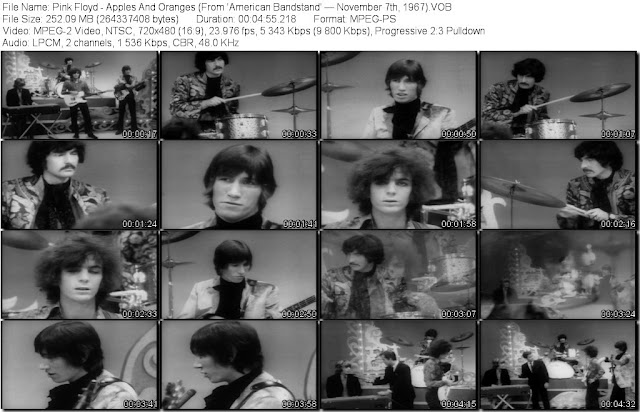
On November 5 they were on Pat Boone’s television show to promote their new single, ‘Apples And Oranges’ and though Syd mimed perfectly during rehearsals he refused to move when the cameras went live.
Roger: “We did the Pat Boone show, and we were taping the show, and he would do the run-through and Syd would stand with his Telecaster with silver bits all over it and mime happily. ‘Cut, cut, we are going to do it now’... He knew perfectly well what was going on, he was just being crazy and they did four or five takes like that. Eventually I mimed it.”
Despite this, Pat Boone chose Syd to talk to and asked him an inane question about what kind of things he liked. Syd fixed him with a Night Of The Living Dead-style stare and pondered the question. The rest of the band waited for what seemed like an eternity, buttocks clenched in horror as they saw their American career going down the tubes. Eventually Syd said ‘America’, which made the all-American audience holler and shout their approval. 

On Dick Clark’s American Bandstand Syd half-heartedly mimed, as if catatonic, through ‘Apples And Oranges’ and ‘See Emily Play’. For Perry Como’s show, it was Rick who had to mime ‘Matilda Mother’. After this, Andrew King finally accepted reality and cancelled a Beach Party TV appearance and a New York engagement at the Cheetah Club and put the group on a plane home. Before leaving Syd managed to fall into the Tropicana pool fully clothed and just abandoned his wet clothes in his room when leaving for LAX. 


Thursday, 20 January 2022

HAL 9000 - DID HE COMMIT MURDER?


As far as cinema history goes the Hal 9000 from Kubrick's 1969 masterpiece 2001 A Space Odyssey might possibly be the most peculiar and omnious villain to ever grace the silver screen because of how chillingly rational he is, and also because hes not a human being. But to this day people are still debating whether the Hal 9000 was trully evil, or did he do it based on a cyber glitch called 'hofstadter moebius loop'. Many have theorized that HAL, the computer genius turned villain of the spaceship Discovery, went mad during the Jupiter mission. However there is an alternative theory: that HAL acted rationally and logically, indeed with cold, calculating precision befitting a machine of his intelligence. 

But to find all this out you need to follow some detective principles, such as; Hal's origin, personality trails, beliefs, values, and intent. Also what he did, the reason why he did it, and who he is. This debate continues to go on because its beyong subjectivity, it asks the profound question 'do computers have a soul?'.

Mathematician Alan Tourin who back in the 1940's answered the question of whether or not machines are capable of thought:

''If the response is generated by a machine during conversation were indistinguishable from the responses that a human would make in a similar then it stands to reason that the machine was indeed thinking, as how does one find the correct response during conversation, other than to think of that correct response.''

In 2010 there was even a banned thought experiment relating to future AI's that would target individuals to do their evil bidding called Roko's Basilisk which I will leave you a link to check out: SLATE magazine

Even philosopher Daniel Dennett asks, “Did HAL commit murder?” His chapter, published nearly 25 years ago in ''HAL's Legacy'' a collection of writings that explore HAL’s tremendous influence on the research and design of intelligent machines, remains an indispensable introduction to the thorny problems of “murdering” by computers and the “murder” of computers. He focuses on the central concept of mens rea, or “guilty mind,” asking how we would ever know when a computer would be so self-aware as to satisfy the legal criterion to make him (it) guilty of murder. 

In 1962 Arthur C. Clarke, who wrote the novel – and co-wrote the screenplay for the movie – “2001: A Space Odyssey”, he visited Bell Labs before putting the finishing touches on the work. There, he was treated to a performance of the song ‘Daisy Bell’ (or, ‘A Bicycle Built for Two’) by the IBM 704 computer. This evidently inspired him to have HAL sing the song as an homage to the programmers of the 704 at Bell Labs, John L. Kelly, Carol Lockbaum, and Max Mathews. Kelly and Lockbaum programmed the lyrics, and Mathews the accompaniment.

The novel explains that HAL is unable to resolve a conflict between his general mission to relay information accurately and orders specific to the mission requiring that he withhold from Bowman and Poole the true purpose of the mission. With the crew dead, he reasons, he would not need to be lying to them. 

He fabricates the failure of the AE-35 unit so that their deaths would appear accidental. In other words, HAL is asked to lie, and he doesn't take to it very well, to say the least. The conflict between his mission objectives backs him into a corner where he has to make some pretty big (and cold) leaps in logic in order to reconcile the paradox in his programmed orders. But also Hal was incapable of abstract thought which is why he wasnt able to understand the difference between a secret and a lie, which created a loop of paranoia in his psyche which conflicted with his programing, and when he finds out his crew members wanted to shit him down he goes into survival mode. He didnt know the difference between sleep and death so he followed through on the only solution he thought was logical. This is how we know Hal could feel some human emotion, and the unknown instils fear within him, which is why at the end he tells Dave ''Im afraid''. And emotion is the primary catalyst for irrational behaviour. What Hal did was evil because of the moral code ''thy shall not kill' but to Hal the greater good was that he successfully complete his mission to Jupiter, so his programing prevented him from seeing what he did was wrong.

Even now in modern times the mystique of Hal 9000 hasnt diminished. When the Kubrick exhibition arrived in London the longest selfie line was for people to have a photo with the original Hal 9000. Here below is a photo of cult filmmaker Fabrizio Federico with the famous AI.

In the end lets leave it to the films director to settle the score. In an interview, Stanley Kubrick gave a quote which supports this reading, saying, "In the specific case of HAL, he had an acute emotional crisis because he could not accept evidence of his own fallibility. ... Most advanced computer theorists believe that once you have a computer which is more intelligent than man and capable of learning by experience, it's inevitable that it will develop an equivalent range of emotional reactions — fear, love, hate, envy, etc. Such a machine could eventually become as incomprehensible as a human being, and could, of course, have a nervous breakdown — as HAL did in the film." 

Filmmaker Fabrizio Federico with the original Hal 9000


Monday, 17 January 2022

FANZINE: Friends Of Syd Barrett


Over the years there have been so many Syd Barrett & Pink Floyd fanzines; there was a particular boom in the 80's thanks to various major news stories, but out of all of them one stood out the most in the American underground. Here is the founder Bob Koenig of the fanzine Friends Of Syd Barrett talking about his journey:

*When did you 1st get into Pink Floyd? 

In the 1970’s I was into a lot of 1960’s music, especially Psychedelia and garage bands. Looking for something wilder and way out that Sgt. Pepper; it was only natural for me to find out about Syd.

*What was it about Syd that made you want to start the fanzine? 

I felt he was an unknown artist that needed more of an underground push to be seen above ground. I started the Zine late 1980’s with no idea where it would go.  The first issue was mostly reprints of older articles. Each issue, I added more original material, be it reviews of CD’s just coming out; Bootlegs, tapes. 

By the third issue, it took notice of Tower Records magazine, Pulse , and after that review I sold well over 300 copies of the issue!! There were a couple stores in NYC that sold the Zine for me, “See Hear” a zine store, and “Revolver Records” so it had a bit of a following.

Then, once after pulse listed the Zine, people from all over the globe would order it. I placed an ad in Goldmine Magazine, too.

I also received mail and phone calls, many from overseas who would track me down and call in the middle of the night with Syd stories. One person swore they had tapes of Syd singing songs that later appeared on “Dark Side” and “Animals”. When I asked to hear them, of course they never came through.

 By issue nine, I had many things going on, not to mention a musical venture of my own. So, I just stopped it. Later, I kind of  started a zine again, only this time it was titled “Esoteric Popular Culture” and the first issue of that was kind of issue ten of FOSB. 

*Did you ever meet Syd or see him live? 

No. I guess mostly because I’m from the USA. Many would ask where Syd lived, but I often told readers NOT to try to find him or track him down. I didn’t believe in making things worse for him. 

*Whats your fav song of his? 

Now, that’s tricky. I had a music Duo called “The Jim-Bob’s” and we used to perform “Baby Lemonade” quite often.  I really like “Dominoes” and “late Night”. Of course, the whole first Floyd album is a must!! I wish they had a recording of his “Have You Got It Yet?” “Jugband Blues” would be another fave.  

*What was ur fav article in the fanzines? 

In issue four, a friend wrote an article comparing Syd with Robyn Hitchcock! Issue #8, I believe, talked about this comic book “Synn, the girl from LSD” (AC Comics) The comic had a lot of Floyd Barrett Illusions, and because of that I made a good connection with the comic people, and we’re still friends today.

I was trying to set up an interview with Jerry Shirley which never happened; and one with book author Nicholas Schaffner, who sadly passed away before the date was set! However, the guys who wrote the book “Crazy Diamond” did respond for a brief mention.

*What do you think Syd contributed to music in 1967?

While I love John Lennon’s compositions and his psychedelia musings, Syd with the “piper” LP debut seemed way ahead of his time. Maybe that was the problem with Syd…he was too ahead of all of us. John Lennon, George Harrison, Ram Dass…all seemed to have a new connection worldly and galactically after ingesting LSD. I’m not suggesting everyone go and do it; because there seems to come a price to it. 

We can only imagine where Syd could have taken us; I’m just thankful to have what we have of his music.

BUY: FRIENDS OF SYD BARRETT

LISTENDominoes (Bob's cover)


Friday, 14 January 2022

REVIEW: Paranoid Alice 'Live at the Factory'


A masterpiece in left-field experimental rock music, which combines every technique under the sun, from buzzsaw guitar feedback to ghostly bass, drums played with bananas, exotic sitars, and low-fi keys. Its a tidal wave of sound, linking everything that was unique about the Velvet Underground, Brian Jonestown Massacre & 80's Jesus & Mary Chain and turns it up to 20!

Its five tracks each capture a distorted feel mixing the rumble of footsteps walking down a misty midnight alley and Jack The Ripper waiting in the wings to stick his knife down your throat. Opening track 'Dreams Are Only Meant To Be Dreamt' is exactly this. Drummer Mat Kenny hazely plays his drums using bananas as mallets, while bassist Luca Crews stalks the beat as it amps up. Guitarist Fabrizio Federico can be heard in the background playing spider web licks as the song dares to look into the sun until it blinds you.

LISTENhttps://youtu.be/ZDuvyGwAe0I

Mixing psychedelic sounds, grunge, pop and classical avant-garde, the band are in a league with current bands pushing sonic bounderies such Black Midi, Empath, The Horrors, Gnoomes & Greys. 

'Morphine' captures everything right about a band in the middle of a fist fight to break through each others eye sockets. The song speeds into an apocalypse of meyhem. 'Pop Girl Of 1966' has a seductive swagger as if its walking down a New York City street dressed in leopard print and Edie Sedgwick sunglasses.

As the album progresses the titles explain it all, experimental music has never been so outrageous and free as this. 'Vietnam Underground' is the sound of a plague of flies, voodoo feel to it, as the guitar phase creates a witchcraft sense of dread with a paranormal call and response between bass and drums similar to a Vietnamese napalm ridden jungle.

The albums closer 'Angel Dust' is the track that pushes the brains nerves to the absolute limits even incorporating sitar into the mix as each member dances into a tornado of supersonic future sounds leaving the listener bleeding.


Thursday, 13 January 2022

The Enigma Of Rik Mayall


Who really was Rik Mayall?? To this day no one will actually be able to tell you out of all the memorable characters he invented which one comes closest to the real man.
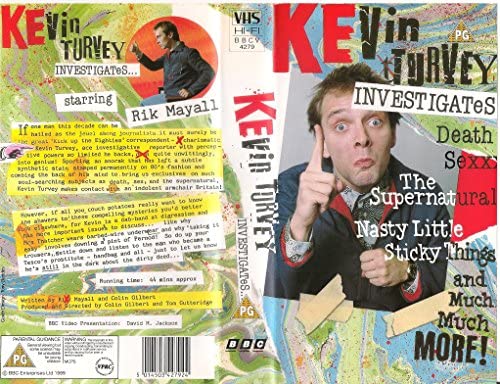
The famous funnyman starred as the the self-styled Redditch reporter Kevin Turvey who lived with his mother in A Kick Up The Eighties and the mocumentary Kevin Turvey – The Man Behind The Green Door in 1982. His portrayal of Redditch's own Kevin Turvey saw the reporter searching for scoops around the borough, taking him to the ring road, the water tower in Headless Cross and on the pitch at the Valley Stadium. Kevin’s tour de force is a long, intricately plodding monologue about His Average Day. He gets up very late and goes down to Tesco, where he buys some cornflakes, which he then takes home and puts into a plate before sitting down at a table with the flakes in front of him... etc. 'I was just sitting there eating my cornflakes. I don’t know how many I had had. Fifteen, sixteen, maybe. I wasn’t counting.


Then in The Young One's Rick was a self proclaimed anarchist in,but in reality he was a spoilt brat only child fan of Cliff Richard! Rick is in his early twenties, sporting short untidy brown hair [sometimes featuring a plait] and a spotty complexion. He habitually wears a black blazer with various anti-establishment pin badges attached to it, and trousers that are far too short for him.  Personality & Lifestyle  Rick is depicted as a petulant, egotistical, self-serving, tantrum-throwing, hypocritical young man who proclaims himself to be an anarchist. Like the rest of the main cast, he is a student of the fictional Scumbag College, although is never seen actually attending any lessons or lectures. 


He is an attention-seeker and frequently seeks to be the centre of attention amongst his friends by trying, and failing, to be humourous. In "Bambi" his attention-seeking becomes so extreme that he attempts to kill himself in front of Vyvyan and Mike by consuming a large amount of pills he finds in a bottle on top of the fridge. Vyvyan points out moments later that Rick is in fact eating laxative pills. Like his Bottom character, Rick is a virgin, making him the focus of regular taunting by his insane flatmate Vyvyan. This does not stop him bragging about alleged sexual encounters he has had. His lack of experience becomes apparent when, at a house party attended by a group of girls, he routes through one of their handbags and takes out what he believes to be a toy mouse; the small white object turned out in fact to be a tampon.   

His relationship with Vyvyan is very similar to the dynamic of Richie and Eddie, with the two at odds which each other almost all the time, usually resulting in violent physical assault. Over the course of twelve episodes, Vyvyan is seen to poke, prod, punch, stab and hit Rick with all manner of household objects, including planks of wood, a cricket bat and a hammer. In one violent encounter, Vyvyan tries to kill him with a Howitzer machine gun.  
Like his Bottom counterpart, Rick is a fantasist and brags about things and experiences he has never actually taken part in, often failing to maintain his lies resulting in ridicule, ridicule from the rest of the cast. He believes himself to be very attractive, successful and has a wildly distorted view of his own self-importance. He claims to be studying sociology, however mentions that he is studying domestic sciences as well. He is also an aspiring poet, and is seen to compose poems on a small tatty piece of paper, before quoting them to the rest of the housemates, although most of the time none of them pay any attention. Despite his apparent literacy, he has trouble reading the newspaper and admits that he, like Vyvyan, is unable to tell the time.  

Rick maintains an anti-Thatcherite disposition, and often goes into long rants about his opinion of the British institution, the Conservative Government and the state of the UK as a whole. He perceives himself to be a revolutionary in the face of the government, however appears to have little understanding of the causes he claims to fight and protest against. In "Summer Holiday" it is revealed that he was born to upper class left-wing parents, and is an only child. He claims to be a vegetarian, an agnostic, and wishes all men to love each other like brothers, apart from Neil, who he hates.   

He looks down on Neil and dismisses him simply as a "stupid bloody hippy." Like the rest of the household, he ignores Neil for most of the time, even when Neil is trying to tell him, Mike and Vyvyan that he has decided to kill himself. His relationship with Mike however is more amicable, as he appears to admire him and always tries to impress him. Rick suffers from rhoticism - a speech impediment which prevents the speaker from properly pronouncing the letter 'R.' He may in fact have a fetish for transvestism, when Neil finds a woman's dress in his wardrobe with his name stitched on the label. 


Sex-obsessed, inappropriate, petulant, socially awkward and possibly insane; Richard "Richie" Richard lives to pursue only one thing - getting someone to "do it" with him. In the first chapter of Richie's depraved trip down misery lane, he is returning home from an unsuccessful trip to the Lamb & Flag with his equally depraved best pal Eddie, where his excessive use of 'gonad-enhancers' failed to impress any of the female patrons. Although notably more sure of himself, Eddie's attempts to score are equally disastrous.  But the night is young, and after a brief brainstorming session in the world of lonely hearts ads, the discovery of a revolutionary new pheromone sex-spray leads Richie and his only friend to the local sex shop and back to the pub. After trying it on with two uninterested lesbians, an unprovoked assault on a condom machine and a whack in the face by the local hard-knock, so begins Richie's magnum opus of nob-gags, double-entendre, frying pan frivolity and violent testicular distortion.


Then theres the megalomaniac Alan B'Stard is a sociopath and throughout the series it is revealed that he has only gotten as far as he has because of his frequent lying, backstabbing and scheming. He is selfish, sadistic, arrogant, self-obsessed, lecherous and greedy. He is obsessed with making money, even if it means acquiring it through criminal means, and he is not limited to attempting murder to do it.  Marriage & Relationships  He is married to long-suffering wife Sarah B'Stard, a marriage of convenience based on the mutual benefit it brings them both. Sarah because of Alan's wealth, and Alan because Sarah's father is the leader of the local Tory Party and holds his seat in gift. 

Throughout the series both Alan and Sarah are seen cheating on each other with various people, and it is revealed early on that Sarah is bisexual. Sarah's ultimate goal is to kill Alan so that she can live off his inheritance.  Alan is obsessed with sex and is not limited to paying for it to suit his needs. He greatly overestimates his sexual prowess and is often seen beginning the act only for him to reach climax only seconds later, a fact he is not at all bothered about. He views his premature ejaculation as a sign of virility. He has been accused of having sex with minors (off-screen) and this has made its way to the press, with Alan hitting back and successfully suing The Times for slander. In "Three Line Whipping" he is seen attending a brothel and becoming excited at the prospect of whipping a prostitute. The prostitute misunderstands the situation and ends up beating him senseless with the whip, leaving serious injuries all over his back and bottom.


His schemes are wide-ranging, but typically encompass the acquisition of wealth, sex, property and prestige. His adventures have been known to bring him close to death, particularly where he has become embroiled in the affairs of international governments. In "Happiness Is A Warm Gun" he is implied to have caused a car accident between the Labour and Liberal candidates for Haltemprice, leading to him securing a majority vote and therefore becoming the MP for Haltemprice. He was not completely thorough in his plan though, as he immediately comes under the suspicion of Sir Malachi Jellicoe, the Chief Constable of East Yorkshire Police. Jellicoe is corrupt however, and offers to cease the investigation in exchange for Alan's political influence, which he intends to use to pass a law that would arm the police. 

Alan is successful in getting the law passed, despite resistance from strong political figures such as Bob Crippen and the Bishop of Haltemprice. Alan later realises that Jellicoe is in fact, insane, and has been having delusions of God and intends to criminalise Atheism. Alan concocts a plan to out Jellicoe as a lunatic, and convinces him that the Bishop of Haltemprice is the Devil. Jellicoe tries to kill the Bishop, but is pounced on by police, whom Alan had tipped off.  

In "Passport To Freedom," he successfully prevents Sarah from divorcing him by destroying her financial stake in Ocelot Motors, by forging a letter from the Prime Minister detailing plans to de-unionise the industry and reduce wages. The fallout causes Sarah's shares to dwindle to almost nothing, making it impossible for her to afford the divorce.  In "Sex Is Wrong" Alan tries to make money out of a pornographic book by playing to the ideals of a feminist author.  

In "Waste Not, Want Not" Alan's past catches up with him when Norman discovers that the council plan to demolish an old lockup in Hull where Alan once dumped a large amount of radioactive waste before the Falklands War. He hatches a plan to relocate the waste to an abandoned mine.