Showing posts with label the doors. Show all posts

Friday, 9 July 2021

Jim Morrison & The Power Of Crowd Control

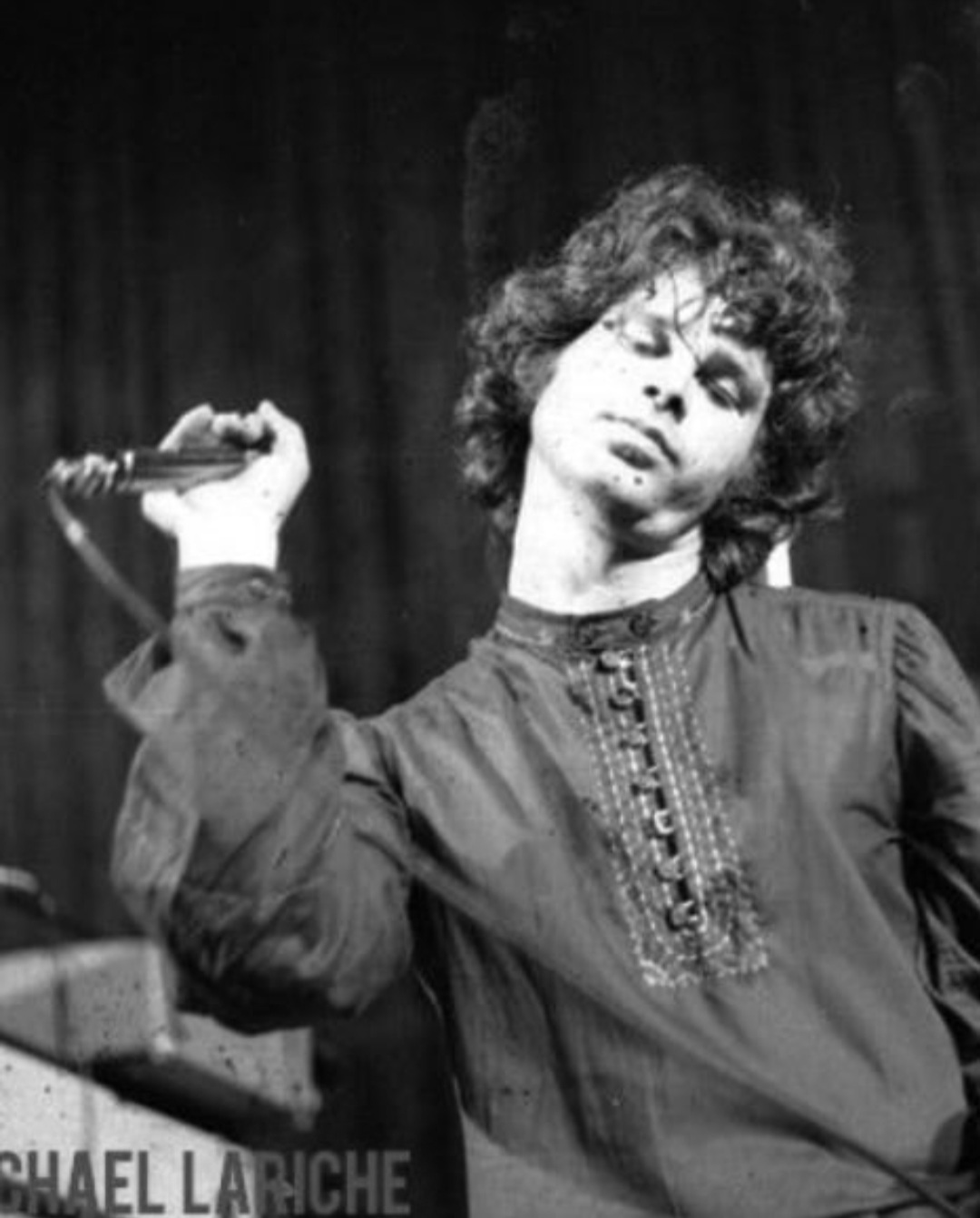
On August 3rd 1968, while 'Hello I Love You' is 1# on the national charts The Doors are on the road, having just rocked The Singer Bowl in NYC, Morrison is at his career best, creating controled chaos, resulting in riots and gaining them front page national headlines. By this stage Jim was now a charismatic psychedelic preacher winding up his fans with his dark poetry, shamanic dancing and antagonistic experimental theatre. The Cleveland gig starts off very shambolically, Jim had been backstage with fans smoking joints and drinking whiskey so by the time Break On Through ramps up the audience it sounds like satanic sludge vamp. 

Filmmaker Fabrizio Federico has studied crowd control and is amazed by Morrison's tactics.  The band are on form keeping a nihilistic demented nightmare vibe going as Jim threatens the audience ''if you dont keep quiet and get real soft im gonna come down there and kill some people!". The shenanigans continue when he starts teasing them ''hey listen I wanna tell you the history of me. I dont know how I got here but here I am''. Jim was fascinated with crowd control ever since attending college, even devouring Crowds & Power' by Elias Canetti. He states on asking questions: "On the questioner the effect is a feeling of enhanced power. He enjoys this and consequentially asks more and more questions; every answer he receives is an act of submission. Personal freedom consists largely in having a defense against questions. The most blatant tyranny is the one which asks the most blatant questions." During the gig Jim asked the crowd ''hey what do you guys wanna hear?'' and also ''what are we gonna get? We're gonna get everything!" Jim once told his Florida classmate Chris Kallivokas, from his Collective Behavior class, "You've got to make them believe you're doing them a favor by being onstage. The more abusive you are, the more they love it."


Canetti also describes a crowd as being a single living organism ''Ideally, all are equal there; no distinctions count, not even sex. The man pressed against him is the same as himself. He feels him as he feels himself. Suddenly it is as though everything were happening in one and the same body. This is perhaps one of the reasons why a crowd seeks to close in on itself: it wants to rid each individual as completely as possible of the fear of being touched. The more fiercely people press together, the more certain they feel that they do not fear each other. This reversal of the fear of being touched belongs to the nature of crowds. The feeling of relief is most striking where the density of the crowd is the greatest.''
Jim talked to the audience as one, ''Get it real soft, you know what im talking about, feels real good, you got a real dirty mind doncha'' - "i want you to feel it deep inside.''

Two years before his death with The Doors coming for their first Florida concert, Chris Kallivokas left a message with his old friend's record company. He says Jim called him back, loving life. "The chicks we get, the money. . . . It's great." "So that crowd control works," Kallivokas teased, talking about theories that intrigued Jim in Collective Behavior class at FSU. He said Jim answered: "You've got to make them believe you're doing them a favor by being onstage. The more abusive you are, the more they love it."

Canetti goes on to classify crowds according to their prevailing emotions, exploring how these dynamics shape everything from political movements to religion to music concerts and how they shed light on the complexities and true meaning of power.
Canetti outlines the four key defining attributes found in varying degrees in any crowd: The crowd always wants to grow. 1) There are no natural boundaries to its growth. Where such boundaries have been artificially created — e.g. in all institutions which are used for the preservation of closed crowds — an eruption of the crowd is always possible and will, in fact, happen from time to time. There are no institutions which can be absolutely relied on to prevent the growth of the crowd once and for all. 2) Within the crowd there is equality. This is absolute and indisputable and never questioned by the crowd itself. It is of fundamental importance and one might even define a crowd as a state of absolute equality. A head is a head, an arm is an arm, and differences between individual heads and arms are irrelevant. It is for the sake of this equality that people become a crowd and they need to overlook anything which might detract from it. All demands for justice and all theories of equality ultimately derive their energy from the actual experience of equality familiar to anyone who has been part of a crowd. 3) The crowd loves density. It can never feel too dense. Nothing must stand between its parts or divide them; everything must be the crowd itself. The feeling of density is strongest in the moment of discharge. One day it may be possible to determine this density more accurately and even to measure it. 4) The crowd needs a direction. It is in movement and it moves towards a goal. The direction, which is common to all its members, strengthens the feeling of equality. A goal outside the individual members and common to all of them drives underground all the private differing goals which are fatal to the crowd as such. Direction is essential for the continuing existence of the crowd. Its constant fear of disintegration means that it will accept any goal. A crowd exists so long as it has an unattained goal.
“He was always like that, even from the beginning,” Doors guitarist Robby Krieger tells me today. “We just dealt with it. That was part of the reason that people wanted to see us, they wanted to see what would happen next. It was kinda crazy but we were not a band that just played the same set every night the same way. It was always different and Jim would always lead us somewhere that we didn’t go the night before. He just liked to f*** with people. He hated the fact that some of these bands would just play the same songs night after night the same way and all of us were from a jazz-influenced place, where you did improvisation. So every night the song was different, which kept it interesting.”

The Doors take the stage, and the delay further aggravates the impatient audience. As soon as the Doors appear, they are greeted with a thunderous assault of screaming fans, and segments of the crowd begin rushing the stage. A column of policemen are stationed at the front of the platform to curtail this onrush of people, while Morrison fiercely jostles his way through them to face the crowd. The chaos escalates continuously during the performance, with fights erupting throughout the hall. Morrison who usually sings with a very precise and articulate emphasis on the lyrics, and most of the time actually appears to be substantially more sober than the crowd, but in Cleveland he is blind drunk and stoned. Morrison spun around and ground the songs out half-heartedly, ad libbing, improvising, doing an ominous dance. Hysteria was building. Morrison shrieked, moaned, gyrated, and minced to the edge of the stage, hovering. Hands reached out and grabbed him and the cops had to pry them away. The camera crew ducked a piece of broken chair which came flying onto the stage. Morrison caught it and heaved it back into the crowd. The Doors were hardly visible from any angle because there were about twenty cops onstage." By the time the Doors begin to perform "When The Musics Over," the crowd is in an incredible uproar. Morrison vainly attempts to "sssshhhh" the audience and bum cigarettes ''anyone got a Marlboro? They're the best'', but there is no response and he begins the opening stanzas of the song, Morrison drifts into an expansive passage of poetry. With decidedly steady pacing, he advances through a series of poems, then teases the rowdy audience ''are you reeeeaaadddy???", until he unexpectedly screams, "We want the world & we want it NOW!!!".

On some nights Jim has the atmosphere of 'I'm going down and I'm taking you guys with me' but that did disguise his power to evoke an audience reaction wherever he played. He then starts asking the audience ''hey you guys what do you wanna hear? - one at a time!'' as the whole crowd screams out song titles. During the gig Morrison has a playful but genuine menace in his voice, especially while screaming 'Five To One' over its relentless proto-heavy metal riff. Sounding both threatening and sinister. ''Hey listen we travel from city to city, and we're from California so lets have some fun''. By the time the funky Soul Kitchen and the finale Light My Fire rolls around the audience is in a rapture of excitment. By the end of the Light My Fire solos are over Morrison is trying to quiet the audience down ''come on do it, be quiet!". And then just like that in a flash The Doors have left the building.

Freud said that a crowd demands “strength or even violence” of its leaders: “It wants to be ruled and oppressed and to fear its master”. Sigmund Freud stated that groups tend to have the characteristics of “weakness of intellectual ability,…lack of emotional restraint,...incapacity for moderation and delay, [and] the inclination to exceed every limit in the expression of emotion.” Freud went on to say that groups “show an unmistakable picture of a regression of mental activity to an earlier stage such as…children” 

How to deflect questions

  1. Enlist the help of a friend - "oh come on you know they dont want to talk about that.''
  2. Prepare a canned answer in advance - Let's say you're going into an interview and [you know they will] ask about your managerial experience and you don't have much," she says. "You can use their question as the topic of your answer or just a pivot point. Say, 'I'm so glad you asked! One of the reasons I'm looking for new opportunities is that I anticipate much growth opportunity for managing teams, and that's work I really enjoy and do well."
  3. Use a bridge response to chance the subject - if you really don't care to discuss your views on healthcare with someone, talk about a headline-grabbing (and non-controversial) news story that's tangentially related. According to manuals your classic bridge phrases are going to be "I don't know about that, but here's something interesting…" and "I can't tell you that for sure, but here's something I do know…"
  4. Restate & Re-frame the question - Here are your key phrases: "I think what you're really trying to ask me is…" and "I think what you're really trying to get at is…." For example, if Aunt Margaret asks when you're going to finally get promoted, you can respond with something like, "I think what you're really trying to ask me is how I'm enjoying this exciting time in my career," and go on from there.
  5. Excuse your self - tell them you need to go to the restroom.
  6. Be straight forward about feeling uncomfortable - "Be direct and then pivot,". It's always within your rights to respond to an unwanted question with something like, "It's kind of emotionally fraught, so I'd rather not talk about it. But I'd love to hear about your new [project/job/baby/house]!" See, that wasn't so hard!
  7. Use humour - For example, an intrusive "How much money do you make?" can be waved off with a simple joke, like, "Not enough!" Most people will realize they've overstepped and change the subject.
  8. Answer ambiguously - If someone asks why you haven't quit your miserable job yet to look for a new one, a simple "Who knows? I've still gotta pay the bills in the meantime!" will do. To, "When are you going to graduate?" respond with a vague, "I'm not sure, I guess we'll see!"
  9. Offer advice instead of an answer - For example, if someone asks about your recent weight loss and you don't want to get into the gritty details, simply share a tip about your favorite trainer in town and offer to put the person in touch with them. Or, rather than answering an invasive question about your recent breakup, tell the group about a book recommendation that helped you heal after the separation.
  10. Shame them - Do it in a joking way to keep things light. Something like, "Wow, you're quite the curious one, aren't you?" or "Whoa, I think that's a bit heavy for a party" will shut things down pretty quickly.
  11. Deflect with a compliment - If someone comments on your weight loss or gain in a way that makes you uncomfortable, for example, you could compliment their own appearance. Or, if someone asks you the inevitable "When are you getting married?" or "When are you having kids?" you can change the subject by complimenting the asker's beautiful wedding a few years ago or saying something nice about their child's latest accomplishment. Distraction is key!
  12. Ask a question of your own - If they ask about your relationship status, try something like, "Are you worried that I'm lonely?" To a question about your dissertation or job search, you can say, "Are you concerned about my financial status?"
  13. Ask for advice - For example, if a married person asks you why you're not engaged to your partner yet, you can ask them for their tips on making a relationship work long-term. If someone asks you personal questions about your children or parenting, ask them for tips on how they raised their own kids effectively.
  14. Turn the tables - If they ask about your relationship, evade the question by asking about theirs. If they ask about your frustrating boss at work, ask them how their own job is going.
  15. Create a distraction - ''does anybody want dessert?'' or pop in a movie, or to start a game of football. Especially in a crowd, it's easy to pretend you didn't hear the asker's question and turn to another family member to start a new activity.
  16. Address a related but safer topic - When you're asked about your finances, for example, shift into a story about how you recently started crafting a more effective budget. Instead of answering questions about why you were recently laid off, talk about your new job or how you're approaching your job hunt. Act as if you're addressing exactly what they asked, and the questioner will probably drop it.
  17. Respond with a general answer - For example, if someone asks you about your personal political views around a controversial subject, talk about how frustrated you are with the political climate in general, or mention how great it would be if everyone could come together to have a productive dialogue. In particular, if you shift the tone from negative to positive, the nosy questioner will have to be the downer if they want to bring the conversation back to the original question.

1. Acknowledge the question without answering it.

(“That’s a good question, and I think we should consider the implications by looking at…” [avoiding an answer].)

2. Ignore the question completely.

However, this is a high-risk approach because the interviewer may repeat the question or reword it slightly to return to the subject. This tends to make the interviewee look evasive.

3. Question the question.

(a) Request clarification or further information about the question. This works as a delaying tactic in a short interview.
(b) Reflect the question back to the interviewer (“Why do you ask me that?”)

4. Attack the question,

on the basis of:
(a) The question fails to tackle the important issue.
(b) The question is based on a false assumption.
(c) The question is factually inaccurate.
(d) The question is too personal or objectionable.

5. Decline to answer.

Refuse to answer on the basis that it is not your area of responsibility. (“You will have to ask [name, or ‘someone else’] about that because I’m not involved at all in that part of the situation.”)

6. Give an incomplete answer.

(a) Partial answer.
(b) Start to answer but change the subject.
(c) Negative answer. You state what won’t happen instead of what will happen.

7. State or imply the question has already been answered.

(“I’m not going to go over old ground.”)

8. Defer to the will of others.

Refer to the will of constituents or shareholders etc and imply you are doing your duty by complying with their will. (“Shareholders have asked me to take a firm line on this issue.”)




Wednesday, 26 April 2017

Jim Morrison: THE GENIUS OF AN UNSUNG FILMMAKER


A tribute to one of my favorite unsung filmmakers and an inspiration to my own films
Written by filmmaker Fabrizio Federico

*Fabrizio Federico: OFFICIAL WEBSITE
*Jim Morrison: The Genius of An Unsung Filmmaker (book): Amazon


The power and magic that surrounds Jim Morrison & The Doors is their mythic status, and in an age before Youtube the holy grail in for a Mirrison fan was these stories about how he also made films that were now either lost or impossible to ever see, locked away in the bands archive safe forever. In my mind this created a holy need to experience them. Unfortunately out of the many brilliant achievements Jim Morrison realized in his short life his true love of becoming a film director never flourished, due to his other commitments. But in his short life he did manage on a couple of occasions to leave some examples of how he could have easily changed the face of cinema just as he did with his music.

''Cinema returns us to anima, religion of matter, which gives each thing its special divinity and sees gods in all things and beings. Cinema, heir of alchemy, last of an erotic science'' Jim Morrison

Starting his film studies in 1964 at UCLA his experiences there were not what he originally hopped for, he was misunderstood by both the teachers and many of the students for his forward thinking free-form ideas. From an early age his main influences were Cinema Verite & Surrealism, some of the films he saw in this period were Von Sternberg's - The Blue Angel, The Devil Is A Woman, and his favorite Anatahan. 

Jim managed to cause an uproar after he completed his only untitled student film, which was screened in front of his senior class on May 1965. The film consisted of mixture of primitive chanting's by priests and children, a fuzzy test pattern similar to the Outer Limits sci-fi TV Show, then cut to a group of men smoking and getting ready to watch a pornographic stag film. The film breaks and the screen fills with crude hand-shadow puppets, then they throw darts at Playboy centerfolds taped to the walls of Jim's apartment, over insistent peyote chanting Navajo Indians. A woman is seen from behind walking down the street and disappearing into an elevator, Jim is then seen taking a huge toke on a joint, as his eyes bulge he cuts to stock-footage of an atomic bomb exploding. The he delivers a cheeky wink to the camera. Cut to a wooden console TV with a blonde Aryan bombshell stripteasing on-top of the TV which is screening Nazi storm trooper marches. Finally the girl licks an eyeball to cleanse it of all the toxic imagery from the TV. 

Porn. Drugs. Television. Nazis. Sex. Music. Irony.

No plot, no beginning, no middle, no end. For his minor masterpiece Jim received an F grade, and the film was thrown away, no copy has ever surfaced.
Ridiculed for being an original, he quit UCLA shortly afterwords. But fast forward to 1968 and The Doors are now the biggest band in America and Jim has convinced the rest of the band to make a documentary of their summer tour, a documentary that will perplex just as many people as his first film.

''Early film makers, who—like the alchemists—delighted in a willful obscurity about their craft, in order to withhold their skills from profane onlookers.'' Jim Morrison


The end product was called Feast Of Friends which was self financed by the band and shot through out different cities with the help of Jim's friends Paul Ferrara, Babe Hill, Frank Lisciandro and a young intern called Harrison Ford, in 1968. In many ways the film shows the boredom of touring mixed with the complete anarchy of The Doors shows that summer, causing riots at New York's Singer Bowl, Chicago and in Cleveland. It shows the generation gap between the band and America's mainstream society (ministers at large, cops, promoters).
Jim is seen interacting with his adoring fans (a memorable scene of a wild eyed groupie grabbing his crotch in a limo - and of his consoling a bleeding fan backstage) the band lazily playing cards before a show, a tongue in cheek terrifying Frederick Nietzsche inspired piano improv, we see the band being escorted funeral pyre like from backstage similar to lambs sent to the slaughter, travel and anti-war propaganda announcements fills the movies soundtrack along with many of their greatest songs. 

Jim had a cinematic mind that is clearly reflected in The Doors songs, images are mirrored with sound to create mini-movies for the ears. But what leaves the greatest lasting impression of all is the raw charisma that Morrison had over his fans. Like a witch-doctor he sends them into a frenzy time & time again, they come across as children of the damned in an inferno of magic, a seance of worship towards their favourite band. Jim had clearly learned his stage craft from the magic and alchemy of cinema. The film finally ends with the Hollywood Bowl infamous acid induced performance of The End, try watching it with the light out. Finally the band are whisked away to enjoy the sun on a boat in Hawaii, once again the film ends with a catharsis, the sun clears away the voodoo aura that is so attractive and new to rock fans. Morrison brought ancient shamanism to the rock stage for the first time and it was captured brilliantly in the film.


Feast Of Friends was another disappointment for Jim. The film was received badly at film festivals and was met with a lot of booing. But I wonders whether this is what Jim actually wanted, maybe he was winking at us, some people get irony some don't.

''Cinema derives not from painting, literature, sculpture, theater, but from ancient popular wizardry. It is contemporary manifestation of an evolving history of shadows, a delight in pictures that move, a belief in magic. Its lineage is entwined from the earliest beginning with Priests and sorcery, a summoning of phantoms. With, at first, only slight aid of the mirror and fire, men called up dark and secret visits from regions in the buried mind. In these seances, shades are spirits which ward off evil.'' Jim Morrison

Finally in 1969 he created his cinematic masterpiece, HWY: An American Pastoral. A lonesome hitchhiker (inspired by the serial killer Billy Cook & Charles Starkweather) stalks the desert as he makes his way back to Los Angeles. Filmed with the same team that made Feast Of Friends (excluding Harrison Ford), photographer extraordinaire Paul Ferrara who co-directed with Morrison this mystical poetic film, that conjures up a trip that is seldom seen in cinema. Jim is in full beard and looking every bit the rock start before he shed his Lizard King persona forever, the song Riders On The Storm is essentially a plot synopsis of HWY. 
The film is exquisite, once again Jim proves that cinema does not have to include an ordinary structure. 


The journey starts with Jim swimming in a beautiful desert oasis, as night falls he sleeps rough in an abandoned car which he then proceeds to destroy in a rage as morning arrives, after what seems like hours trying to hitch a ride he mysteriously kills the driver of the vehicle that picks him up in the hot desert sun. 
Morrison financed this low-budget gem with a soundtrack composed by Fred Myrow, the film is a soft parade of desert children dancing away in the wilderness, to images of black ghetto children looking lost and shaken to the sounds of Frank Sinatra's My Way. By 1969 the chaos of the 60's had taken it's toll on the counterculture and you could start to smell the rotting dream of flower power. Because of it's Death Valley imagery HWY brings to mind the Manson Family, who at the time of filming were in the desert plotting Helter Skelter, waiting to put a nail through the 60's coffin. Death lingers in this film, one of HWY's most moving images is of the dying coyote seen making his last gasp's for air on the highway tarmac.

HWY's hypnotic pacing finally brings Jim back to Los Angeles where he mysteriously makes a late night phone call to his friend Michael McClure, confessing to him that he wasted someone ''hey man I really got a problem, I was out in the desert, man...I dont know how to tell ya..but...I killed someone...it's not a big deal I dont think anyone will find out about it - the guy started to give me some trouble and I couldn't take it... so I wasted him.'' 
Then hangs up. 
We seen Jim taking a leak at his favorite local motel, the Phone Booth, to the soundtrack of a lonely piano, then climbing onto a roof top and walking on the ledge of the building in a suicidal death gait. He finally takes a walk down to the Whiskey A Go-Go where he memorably asks the clubs bouncers ''got any groovy pussy in this joint?'', ''any LSD..any LSD in there?''. The film ends on a melancholy note, leaving the viewer feeling almost like an isolated barfly. The LA night skyline stares back at you in disarray.


Once again Jim received no praise or respect for his unique cinematic efforts. The film was screened only a few times, first in Vancouver in 1970 then finally in Paris just before Jim's tragic death. 
From watching his films I consider Jim Morrison to be one of the first true independent filmmakers and there is no doubt that if he had lived he would have created many more incredible films. They enhance his already solid legacy and his films prove that there is an unbreakable bond between alchemy/ritual/shamanism and the power of cinema.


Jim's fav films

The Blue Angel
The Devil Is A Woman
Anatahan
Un Femme Est Une Femme
Pull My Daisy
Rules Of The Game
Un Chant d'Amour
Easy Rider
Morroco
Blonde Venus
8 1/2
The Hitch-Hiker (1953)